
A collaborative process, built around your family
Every child and family is different. The process begins by understanding where you are today, what you would like to change, and whether RDI could be a good fit for your family.
It is to help you understand your child differently and gradually build new ways of interacting and supporting development in everyday life.
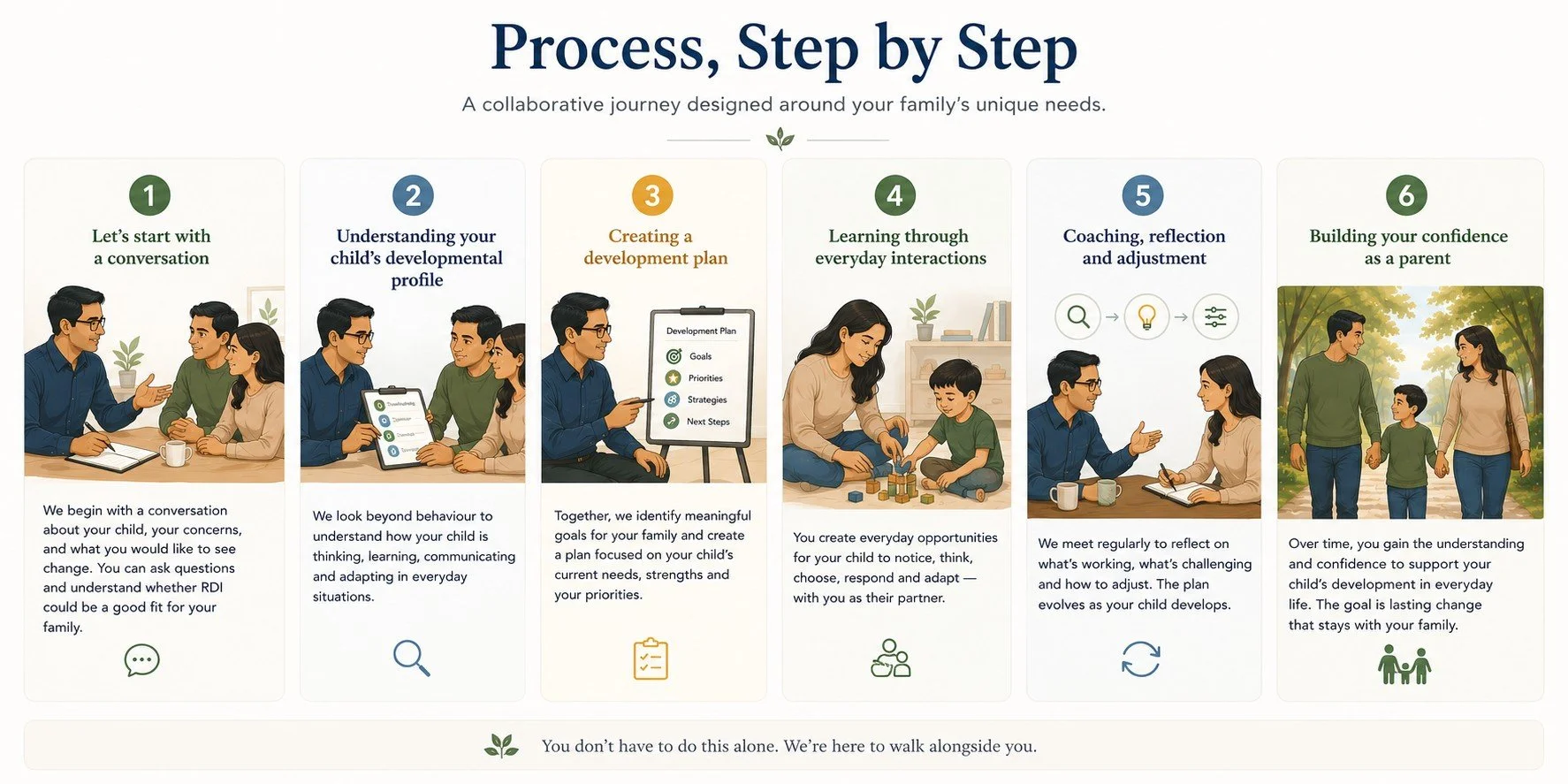
The RDI Process
-
Sessions
At mutually agreed date and time, typically lasting 45-60 minutes each either online or in person. Parents and the consultant will review the work assigned in the previous session, learn new concepts and prepare for next assignment.
-
Assignments
Clear, systematic assignments, tailored to the daily realities of the family. Parents will go back with specific action points to be submitted prior to next session.
-
Assessment (RDA)
Sessions where the RDI proprietary assessment will be conducted, to enable the consultant to come up with a plan.
-
Between sessions
Parents use the online global RDI learning system for continuity and as repository, can also approach consultant with queries.
It takes time to do RDI, but RDI saves time!

My role as a consultant
Assessment of the family and come up with a development plan, while not being overwhelming on your family resources
Transfer my knowledge and abilities to you over a series of clear objectives so you become fully independent in applying the RDI tools
Construct clear, systematic assignments, tailored to the daily realities of your family
Ensure that you have appropriate understanding of how you are expected to work with your child between our meetings
Ethics and Responsibility
All sessions and work submissions by families are treated with strict confidentiality and consent.
-
Yes, RDI helps us to identify and resolve the root causes of behaviour, instead of superficially working on them.
-
RDI focuses on developing intrinsic motivation, dynamic thinking and problem solving abilities in a structured and calibrated manner. RDI also helps in understanding underlying causes of behaviours, if any, and helps address them accordingly - not simply seek to mask the condition with scripted conversations or rehearsed behaviours.
-
Self regulation: ability to take in new information, absorb it and making sense of it.
Joint attention: ability to read and process nonverbal cues, results in an understanding of the mental state of another person.
Co-regulation: ability to dynamically alter actions with respect to the ongoing and anticipated actions of partners.
Episodic Memory: a representation of an event, strongly anchored by an emotional appraisal
Empathy: emotional awareness of impact of own actions on others
RDI is about remediating the core deficits of autism, which are pre-requisites for independent living, in a step by step process of coaching parents/caregivers and incorporating RDI in our daily lives.
-
It implies mental resources needed to prepare for, engage with, adapt to, and learn from uncertain situations, that aid us to function effectively.
Whereas static intelligence is when we expect the same result every time a set of actions is completed, or expect a situation to be managed by following a certain procedure.
RDI builds dynamic intelligence, not by "getting" a child to do something but by coaching parents how to create customized experiences that focus on activating growth seeking, building intrinsic motivation and giving the child mental & emotional abilities that we all count on to navigate life.
-
Children with neurodivergent challenges often have a difficulty making sense of patterns in the environment. Many situations in which child may appear to be deliberately misbehaving or being manipulative, it is likely that the child is not able to regulate and is experiencing anxiety.
Regulation, as used in RDI, refers to a state of relatively low-stress regularity within a dynamic system. It's the experiential patterns and emotional responses that are emphasized in RDI regulatory patterns.
-
Co-regulation is the process by which individuals dynamically alter their actions with respect to the ongoing and anticipated actions of their partners.
It is different from compliance, which is doing an action without having to think about it (being trained to do something in a very precise manner and automatically).
RDI helps build co-regulation by training yourself to engage in regulatory patterns and learning to analyze the interaction.
-
The type of communication that would enhance learning relationship between a parent and his/her child to increase experience sharing, build resilience, focus on thinking process and not just ‘doing’.
Different to imperative language: making requests, asking questions and making demands, used for instrumental purposes. It limits opportunities for problem solving and empowerment.
RDI is about taking a long-term perspective and addressing the core deficits of autism. RDI helps in setting the foundations of mindful communication in place through coaching and practise.
-
A growing body of research underscores the importance of early development and relationship-based guidance for autistic individuals. Read the full research overview https://www.rdiconnect.com/transforming-the-well-being-of-persons-with-autism/